
No Justice: DC's next best jumping-on point?

Art by Francis Manapul

In 2018, DC brought down the curtain on its Rebirth line of comics with Dark Nights: Metal, an epic event book that ended with the destruction and reconstruction of the universe itself. Scott Snyder, James Tynion IV and Joshua Williamson (the brains behind the event) followed this up with No Justice, a four-part miniseries addressing the current state of the DCU. This might all sound a bit too continuity-heavy for new readers, but don't worry - No Justice is in fact an excellent jumping-on point.

As well as starring the Justice League, No Justice also features the Teen Titans and a handful of fan-favourite villains. These characters have been brought together by classic Superman villain Brainiac and sorted into four rag-tag teams to counter new threats that have surfaced in the wake of Metal. Regardless of your level of DC knowledge, you'll find at least a few recognisable heroes in this book and maybe even be introduced to some new favourites. 
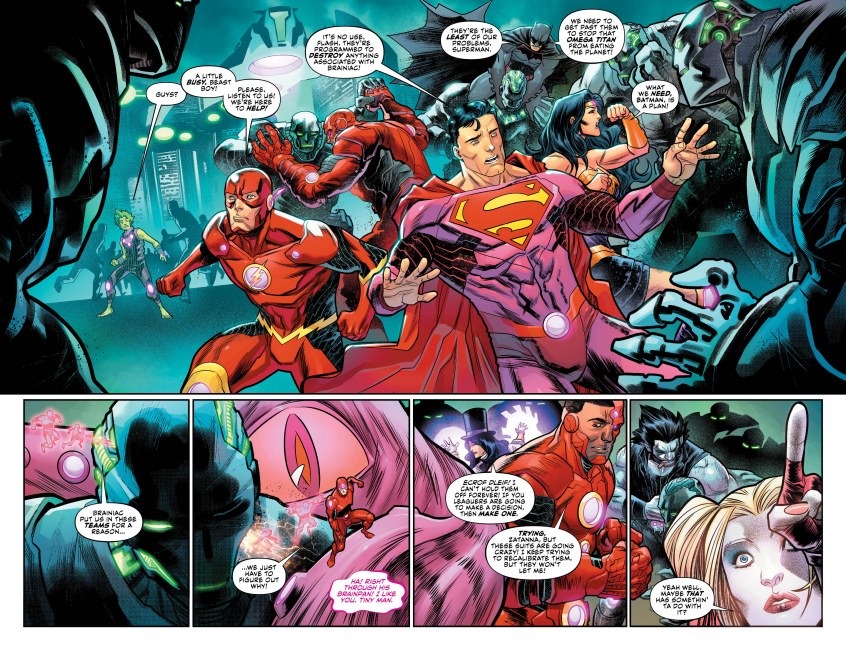
Flash, Beast Boy and Harley Quinn are among those featured in the crossover

The plot is more-or-less your standard team-up adventure - each group is initially very problematic, but they eventually all figure out how to work together. Luckily, Snyder and his fellow writers keep it entertaining with great character dynamics and dialogue, as well as a fair share of plot-twists and world-building. It's a well-paced story that many readers will finish in a single sitting - each chapter drives the plot forward, and it isn't any longer or shorter than it needs to be. 

All it takes is a quick flip-through to see just how visually stunning No Justice is. Francis Manapul's wonderful pencils and inks evoke the feeling of watching a Saturday-morning superhero cartoon, enhanced by Hi-Fi's beautifully ambient colours. Riley Rossmo and Marcus To fill in as artists in the third chapter, but they still keep with the rest of the book's style by following the innovative layouts provided by Manapul.
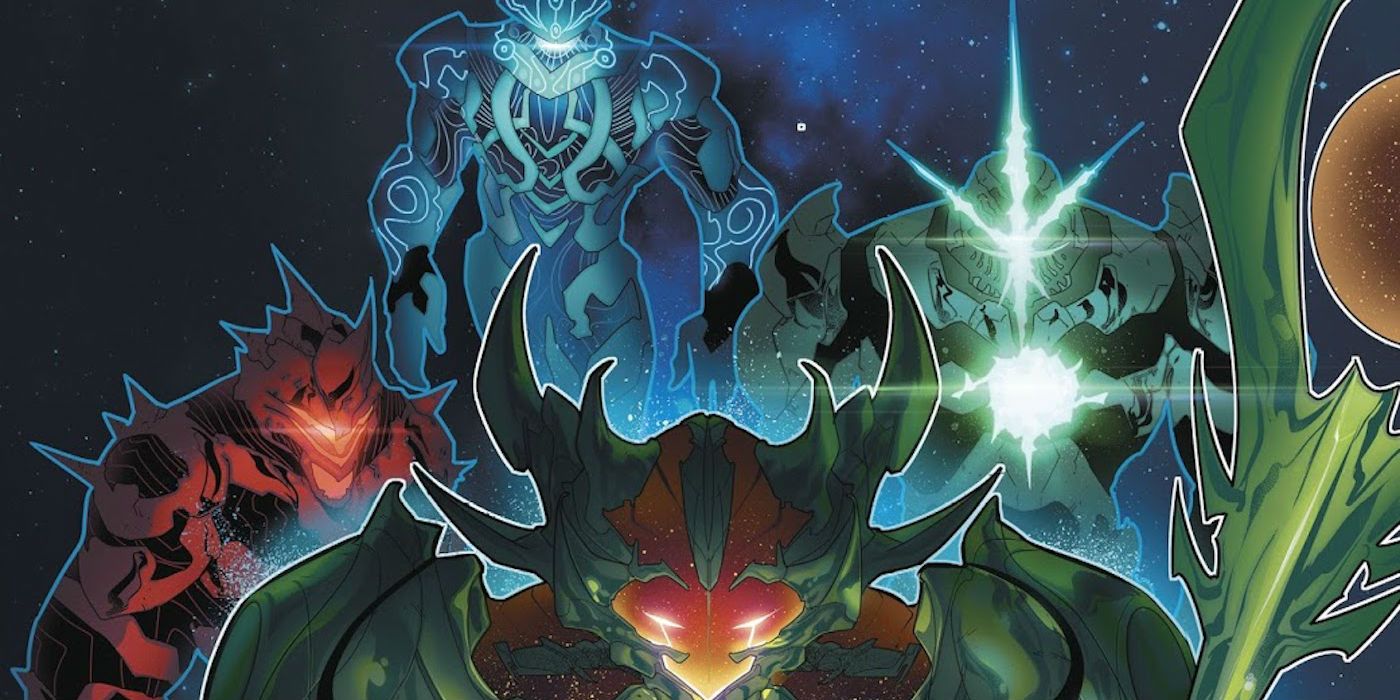
In No Justice, the heroes are up against the colossal Omega Titans

No Justice isn't particularly ground-breaking as far as superhero stories go, but it's still an absolute joy to read. Serving as both the latest-and-greatest place to start for new DC fans and a fresh status-quo shift for seasoned readers, it's a comic that deserves to be recommended to comic readers across the spectrum.

Rating: 7.5/10

All four parts of No Justice are collected in a single paperback volume, also available in digital form on Comixology. If you're still on the fence, have a look at the free prelude, featuring the super slick art of Jorge Jimenez.

Comments

Popular posts from this blog

Why One Piece's Whole Cake Island Arc was a real treat

Primary antagonist Big Mom One Piece 's Wano   Arc is in full swing for both the manga and the anime series, and fans of Japan's favourite comic franchise are loving all of the spectacular samurai action - but let's not forget what came before! Before Luffy and the Straw Hat Pirates arrived in the Land of Wano, they were battling Emperor Big Mom on her home turf to free their chef Sanji from a forced marriage. So, looking back, just how good was the Whole Cake Island   Arc ? The main thing that jumps out about Whole Cake is that it continues to burst with the creativity and flavour that make One Piece so beloved. Whole Cake Island itself is the centrepiece of an archipelago known collectively as Totto Land, each corresponding to a delicious treat, such as cheese, pie, biscuits and candy. These islands are populated by Big Mom's forces and various super-powered commanders, making it a daunting task for Luffy's rescue team to make it in and out unscathed. ...

A thank-you to Steve Ditko

The late Steve Ditko was best known for creating Spider-Man with Stan Lee, and arguably shaped the entire world of superheroes when he did. While Clark Kent was the common man, Peter Parker was the common boy, making him a character that generations of new fans could connect with. Ditko's artwork was dynamic and fun, attracting more and more readers who previously wouldn't have given comics a second glance. His work lives on through new creators, and its influence can be felt in films based on his characters, such as the recent Spider-Man: Homecoming . Steve Ditko is also strongly associated with Charlton Comics - he created Captain Atom, the Question and Ted Kord, the second Blue Beetle. These heroes served as the inspiration for the characters of Alan Moore's  Watchmen , which showed the world that comics can be taken just as seriously as films and television. Ditko had no direct involvement with Watchmen , but it is another example of just how far his influence ...

Looking back on the first Fullmetal Alchemist anime

This year, the first anime adaptation of Hiromu Arakawa's legendary Fullmetal Alchemist manga turns 15 years old. The 2008 remake, Brotherhood , has eclipsed its predecessor in terms of popularity and critical acclaim, but is the 2003 edition still a good show? Each series will not be compared in this review - rather, we'll be evaluating 2003's  Fullmetal Alchemist solely as an adaptation of the source material. As many fans of the franchise are aware, the  Fullmetal Alchemist anime began only months after the manga started. This meant that the production studio, Bones, had little material to work with, so they decided not to follow Arakawa's books panel-to-panel from start to finish. Instead, the anime ended up being a loose adaptation of the first eight volumes, with an original ending. Compared to the manga, the plot is very slow. Many of the major story beats are still there, but there are greater gaps between them, and not everything feels as if it drives ...